The freight costs you could be missing when invoices go unchecked
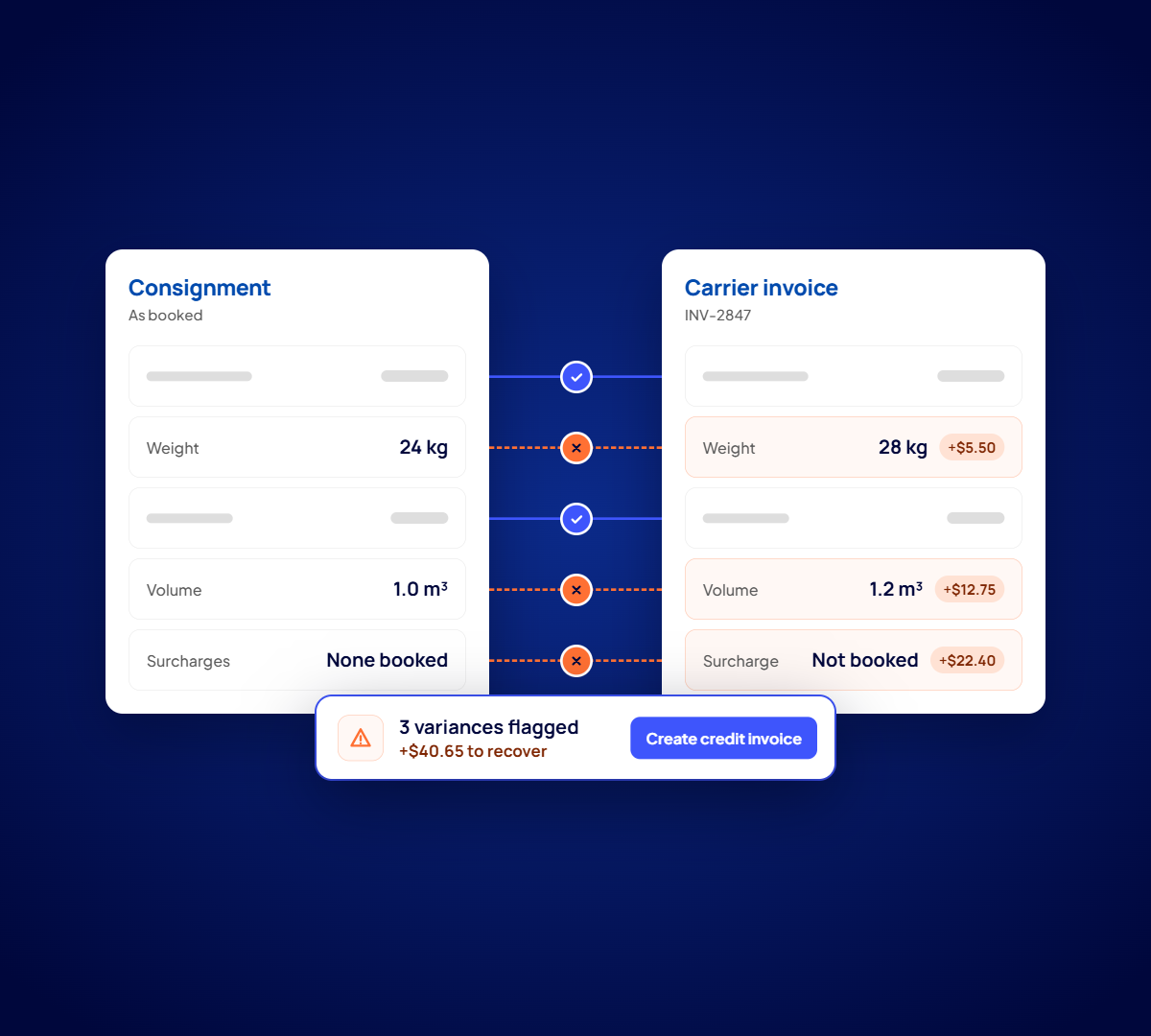
Most New Zealand businesses moving real freight volumes have a version of the same routine. The carrier invoice arrives at the end of the week or the month, it runs to hundreds or thousands of lines, and someone in accounts or the freight team looks it over before it's approved. By then, the freight has long since been delivered and the warehouse is several dispatches past it.
In practice, that review is a spot check. A handful of consignments are pulled and compared against what was expected, and if nothing stands out, the invoice is paid. It's a sensible response to the volume, but as consignment numbers grow, an increasingly large portion of the invoice can go unexamined.
Booking and billing happen in different places
A freight platform earns its keep at dispatch. It quotes the job, selects the service, creates the consignment, prints the label, manifests it and tracks it to the door. That's where most of the attention goes, and for good reason.
The invoice follows a different path. It's issued by the carrier after the fact, often lands with a different team, and gets checked against a PDF or a spreadsheet rather than against the consignment that was actually booked.
The information needed to test each charge already exists. It just isn't sitting next to the invoice at the moment it's being approved. That's the gap reconciliation is there to close.
Where New Zealand invoices tend to move
Two charges worth watching on New Zealand freight invoices are rural delivery fees and carrier re-measures. Both can change the final cost after booking.
Rural classifications vary between carriers, so an address considered rural by one provider may not be treated the same way by another.
Re-measures occur when a carrier finds the actual weight or dimensions differ from those supplied at booking, potentially changing the chargeable weight and final cost.
Neither charge necessarily means the carrier has made a mistake. The important thing is knowing which consignments changed, why, and whether the same differences keep occurring.
Why spot checks don't close the gap
A spot check is good at catching a large, obvious variance, like a pallet charged well above its expected rate or a consignment billed twice. It's far less reliable at catching the small, repeating ones. Rural charges and re-measures usually fall into that category. Each one is modest on its own and easy to miss in a sample of twenty.
Across a monthly invoice, though, they're rarely random. It tends to be the same rural areas, the same SKUs being re-measured and the same lanes drifting. A spot check tells you what happened on the consignments you picked, but it can't tell you whether there's a pattern across the ones you didn't.
The reality for New Zealand businesses
As Philip Robinson, Senior Business Development Manager at MachShip NZ, explains:
“Most NZ businesses we talk to know how much work goes into checking freight charges, but reviewing every line by hand just isn't realistic. So they spot check a handful and move on, knowing there's only so much they can review. Once every line is checked automatically, the conversation shifts from ‘are we being charged correctly?’ to ‘here’s exactly where and why.’ The real question is, how much is your time worth?”
What checking every line looks like
Line-by-line reconciliation turns invoice checking into exception management.
In MachShip, each carrier invoice is ingested, and its entries are checked against the corresponding consignment data, without relying on sampling. Businesses can set their own tolerances, allowing small differences within those thresholds to be automatically reconciled, while discrepancies outside them are surfaced for review. Invoice entries that can't be matched to an existing consignment can also be identified and investigated.
The team then works through the exceptions rather than reviewing the entire invoice manually. Each flagged discrepancy can be accepted or rejected, with a reason recorded. Where a charge is rejected, MachShip generates a credit invoice detailing the disputed amount and the reason for the dispute, ready to send to the carrier.
The aim isn't to dispute every difference. It's to identify which charges need attention, without depending on who had time to check that week.
The part that matters more than recovery
It's tempting to measure reconciliation by what it recovers, but for most businesses, that isn't where the bigger return sits.
For those already reconciling manually, it's the hours given back to the people who have been working through invoices line by line. For those who haven't been reconciling at all, it's knowing, rather than assuming, whether they've been charged correctly.
There's a longer-term benefit as well. Once every line is being checked, the history shows where variances recur by carrier, lane and region. A recurring issue can be picked up and dealt with rather than rediscovered on each invoice. And when rates do come up for review, both sides are working from the same facts rather than a few remembered invoices.
What happens to the lines you don't check?
Spot checking will always have a place, and experienced freight teams in New Zealand know their network well enough to notice when something looks off. The limitation is that it still relies on someone choosing where to look.
When every line is matched automatically, the question shifts from whether the team has time to check the invoice to whether anything on it actually needs their time.
For businesses moving significant freight volumes around New Zealand, that's a far more useful question to be asking.
Insights & Articles


