
Growth should strengthen freight operations, not complicate them. However, for many businesses, the opposite is true. Volumes rise, systems stay the same and workloads increase. Teams spend hours reconciling invoices, chasing proof of deliveries and managing multiple carriers through disconnected tools.
As pressure mounts, visibility starts to slip. Small errors turn into costly issues, and each new customer or carrier adds another layer of complexity. Soon, scaling feels like simply surviving.
That’s where Freightability comes in – offering a fresh perspective on how freight operations can expand, adapt and maintain control.
The Shift in Modern Freight
Freight operations have become more complex, fast-paced and data-focused than ever before. Every shipment now produces streams of information across systems, carriers and customers. For many businesses, the challenge is no longer moving goods; it is keeping up with the information that moves with them.
Legacy processes and manual checks were designed for smaller networks and steadier volumes. They struggle under the pressure of modern freight demands, where growth reveals weak links and disconnected systems slow decision-making. What used to be manageable in spreadsheets now requires automation and greater visibility to remain competitive.
Across the industry, freight leaders are rethinking what efficiency truly means. It’s not just about cutting costs or speeding up deliveries. It’s about control, adaptability and the confidence that operations can withstand pressure. These needs are no longer separate; they have merged into a single focus that defines the next phase of freight operations.
What we’re hearing from freight operators is pretty consistent. Everyone’s chasing visibility and control, but very few feel like they have either. The amount of data coming at them every day is huge, but it’s scattered across so many places that it becomes another problem to manage. Freightability is about turning that noise into something usable and giving teams the confidence that when things get busy, they can still stay in control.
Liam Mallett
Introducing ‘Freightability’
The freight industry has spent years optimising cost and delivery speed. What it has not solved is how to make growth sustainable. Many teams can move more freight, but few can do it without increasing complexity, risk, or manual effort.
That gap is where Freightability comes into play. It describes a business’s ability to manage more freight with clarity and control — to expand without chaos taking over. It’s not a new system or feature; it’s a way to measure how prepared an operation is to adjust and perform when the pressure is on.
You have heard of profitability and scalability. Freightability sits alongside them as another indicator of operational health. It shows whether a freight operation has the visibility, flexibility, and stability to perform at its best, regardless of how much demand shifts.
The Three Pillars of Freightability
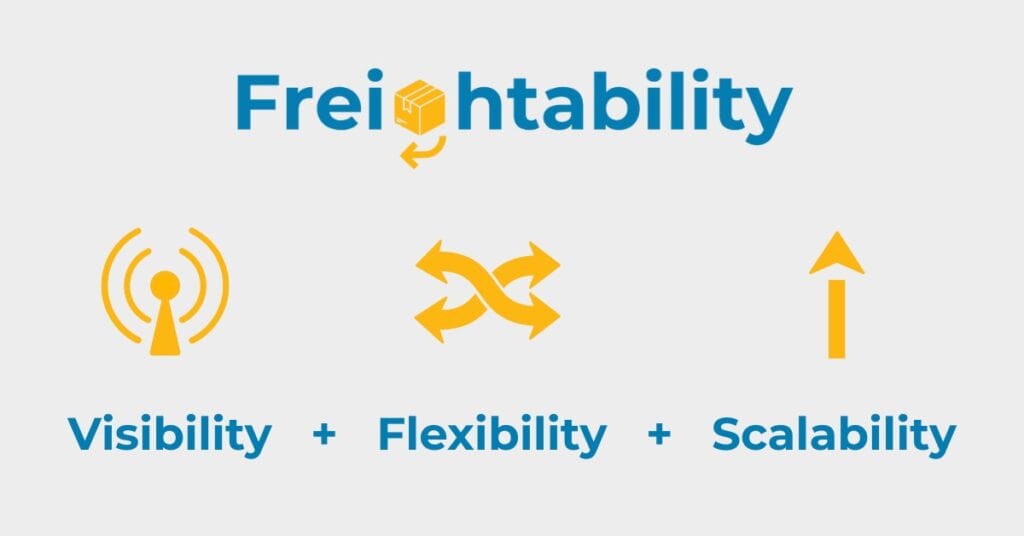
At the heart of Freightability are three key capabilities that define how effectively a business can expand its freight operations: visibility, flexibility and scalability. Together, they influence how smoothly freight moves, how swiftly teams can adapt to change and how confidently a business can grow.
Visibility
You can’t control what isn’t visible. However, in many operations, data remains scattered across carrier portals, inboxes and spreadsheets. Delayed updates and missing cost details make it hard to understand what is truly happening in the network.
True visibility goes beyond tracking freight on a map. It includes understanding the costs associated with each carrier, assessing which routes are performing well and identifying where bottlenecks or risks are starting to appear. It provides operations leaders with the clarity to address issues early, rather than react too late.
When teams have that level of insight, decision-making becomes quicker and more assured. Exceptions can be handled before they impact customers and freight performance ceases to be guesswork. Visibility transforms information into foresight — the foundation on which every other aspect of Freightability relies.
Flexibility
The freight environment is always changing. Carriers reach capacity, customer demands shift and market conditions can change suddenly. Operations based on fixed processes struggle to keep pace.
Flexibility allows freight teams to adapt smoothly without losing momentum. It involves switching carriers when rates fluctuate, rerouting shipments during demand surges and seamlessly integrating new systems or partners.
That level of adaptability doesn’t come from spreadsheets or manual coordination. Instead, it stems from connected systems and automation that give teams the ability to adapt. When a business can pivot quickly and still deliver on time and within budget, flexibility becomes a competitive advantage, not just a contingency plan.
Scalability
For many freight teams, growth is the point when processes start to break down. Volumes increase faster than systems can handle, and manual effort rises simply to keep pace. The result is overtime, errors and stalled progress.
Scalability ensures that, as freight demand grows, the operation remains steady. Workflows and technology manage growth rather than relying on staff to do more to fill gaps. It involves designing processes that expand smoothly with volume, rather than having to rebuild every time the business reaches a new level.
A scalable operation relieves teams from constant catch-up. It creates space for strategic growth — exploring new carriers, analysing data and improving customer experience. That is the true measure of Freightability: when growth generates opportunity, not chaos.

Why Freightability Matters
Freight operations lacking Freightability often feel busy but fragile. Teams keep things moving, but only through constant manual effort. Visibility gaps lead to missed costs. Errors go unnoticed until they reach the customer. Small delays turn into bigger disruptions because the systems behind them cannot adapt or scale quickly.
The impact appears in time, money and morale. Resources that could be used to improve service or strategy are instead busy fixing daily issues. Growth becomes harder to maintain, and every new lane or carrier adds pressure rather than opportunity.
In contrast, a freight operation with high Freightability works with steady confidence. Visibility turns data into insight. Flexibility allows teams to adapt smoothly. Scalability ensures that as the business grows, the workload doesn’t. Together, these qualities create control — the kind that supports better decisions, improved customer outcomes and lasting efficiency.
Building Freightability: Where to Start
Freightability does not happen all at once. It is built gradually, as teams replace manual effort with systems that bring clarity and consistency. For most businesses, the first step is automation.
Automating high-friction tasks like invoice reconciliation, proof-of-delivery tracking and carrier management delivers an immediate lift in visibility and control. It eliminates repetitive work, uncovers hidden costs and allows operations teams to focus on strategic thinking rather than just reacting.
From there, the aim is to connect systems so that data flows seamlessly between carriers, finance, customer service and leadership. Once information is unified and accurate, decision-making improves at every level. That is when Freightability becomes part of how a business runs, not just something it aspires to.
Freightability isn’t a new buzzword — it’s something we’ve seen take shape in the best-run operations. It starts small, with teams automating the tasks that slow them down, and grows into a culture of better decision-making. When visibility, flexibility and scalability start working together, the whole business feels it, not just the freight team.
Liam Mallett
Putting Freightability into Practice
Freightability isn’t just a single project or tool. It represents a broader shift in how freight operations are managed — one in which visibility, flexibility and scalability work together to deliver lasting control and efficiency.
In future articles, we will explore each pillar in greater detail, starting with visibility and its role in creating stronger, more adaptable freight networks.
Follow MachShip on LinkedIn or subscribe to our updates to stay informed as we continue exploring how modern freight teams are putting Freightability into action.